

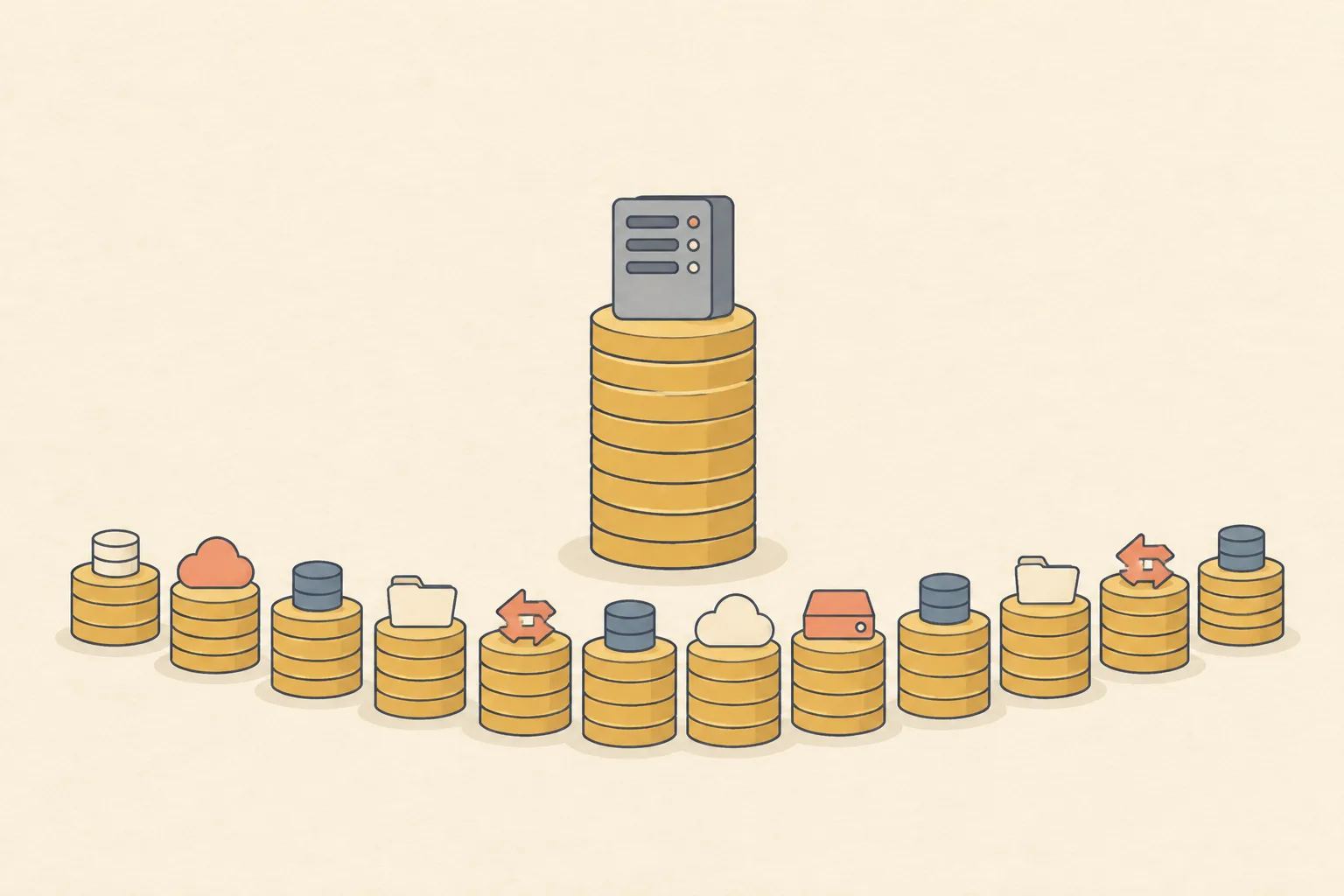
A small cloud server, the kind that runs a blog, a staging site, or a side project with modest traffic, costs about six dollars a month on the major providers. That figure appears on every pricing page, sits at the top of every comparison article, and functions as the industry's official answer to the question. It is also close to meaningless as a budgeting number, because almost nobody who runs a server for more than a few weeks pays only the sticker price on the compute instance.
The gap between the advertised figure and the real monthly bill is where most of the useful knowledge about cloud hosting lives. The six-dollar server is a component, one line item among many, and the surrounding line items have a way of quietly doubling or tripling the total before anyone opens the invoice and wonders what happened.
The compute instance is the smallest part of most bills
Take a typical small deployment: a web server, a database, and some object storage for uploaded files and backups. The web server might run on a two-core, four-gigabyte instance that lists around twenty-four dollars a month. The database, if it is managed, starts around fifteen. Storage for a few hundred gigabytes of files and snapshots runs another ten to twenty depending on access patterns. None of these numbers is outrageous on its own.
Then the add-ons arrive. A static IP address, a load balancer for redundancy, a managed DNS zone, a monitoring service, a log aggregation tool, a backup schedule that retains thirty days of snapshots. Each one is small, often between two and twenty dollars, and each one is easy to forget when the mental model of the bill was built around the instance price. A server that advertises at six dollars frequently bills at forty to sixty once the supporting cast is in place.
The pattern is consistent enough to be a rule: the compute instance is the visible cost, and everything that makes it useful is the actual cost.
Egress charges punish success
Data transfer out of the cloud, called egress, is the line item that surprises people most often. Inbound traffic is almost always free. Outbound traffic is metered, typically somewhere between five and twelve cents per gigabyte on the major platforms, with the first chunk of each month often waived.
For a small site serving text and compressed images, egress stays trivial. A few hundred visitors a day might push out ten or twenty gigabytes a month, well inside the free tier. The trouble starts when a project succeeds. A post goes viral, a video gets shared, a client downloads a large dataset repeatedly. Suddenly the bill includes a transfer charge larger than the compute instance, and the scaling story the provider sold turns into a meter running against the project's growth.
This is the structural oddity of cloud pricing: the provider profits when the customer's traffic increases, and the customer's costs rise precisely at the moment the project is doing well. A dedicated server with a fixed bandwidth allotment inverts that relationship, which is why some teams migrate back to bare metal once their egress bill crosses a few hundred dollars a month.
Managed services multiply the line items
A server is rarely just a server. It sits behind a database, a cache, a queue, a search index, a content delivery network, and an identity provider, and each of those services carries its own pricing model. A managed Redis instance small enough to hold a session cache might cost fifteen dollars a month. A managed Postgres cluster with a read replica and automated backups can easily reach a hundred. A search service, a message queue, a serverless function tier: the bill becomes a list of a dozen services, each priced on its own axis of compute, storage, and requests.
The convenience is real. Managed services remove the operational burden of patching, failover, and backup verification. The cost is that the bill stops being legible. A team that started with one server and a database now reviews a statement with thirty line items, several of which nobody on the team can confidently explain. Finance asks for a forecast, and the only honest answer is a range with a wide spread.
The hidden tax of idle resources
Cloud servers are provisioned for peak load and billed for the whole month. A server sized for a traffic spike on launch day sits mostly idle for the other twenty-nine, and the provider charges for the capacity regardless. The same is true of databases sized for a busy quarter, load balancers kept for a migration that finished in March, and snapshots retained long after the server they captured was deleted.
Idle resources are the cloud's version of a gym membership: paid in full, used intermittently, and rarely audited. A quarterly review of a modest deployment commonly turns up twenty to forty percent of spend attached to instances, volumes, and services that no longer serve any live purpose. The waste is invisible because nothing breaks when it accumulates, and the invoice simply grows a little each month in a way that is easy to attribute to "usage."
Right-sizing is the standard remedy, and it works, but it requires someone to actually look. Most small teams do not have that someone, which is how a four-core instance ends up running a service that peaks at eight percent CPU for two years.
Support plans and the price of a phone call
Every major provider sells support as a percentage of the monthly bill, typically ten percent for business hours and higher for twenty-four-hour response. On a small account the fee is modest. On a larger one it becomes a meaningful line, and the tier structure means a team that wants a guaranteed response time during an outage pays a premium proportional to everything else it spends.
The alternative, relying on community forums and documentation during an incident, works until it does not. The first time a production database fails at two in the morning and the only recourse is a public ticket queue with no response commitment, the support plan stops looking optional. That cost belongs in the real monthly number from the beginning, even though it appears on the pricing page as a footnote.
What a realistic monthly figure looks like
For a small production workload, meaning a web application with modest but real traffic, a managed database, backups, monitoring, and a support plan, a realistic monthly total in the current market lands somewhere between eighty and two hundred fifty dollars. The low end assumes a single region, no redundancy, and careful attention to egress. The high end assumes a load balancer, a read replica, a CDN, and a business support tier.
A hobby project with one instance and no managed services can genuinely run for ten to fifteen dollars. A staging environment that mirrors production adds most of the production cost a second time, which is why many teams run staging at reduced capacity or spin it up only during working hours.
None of these figures is a scandal. The scandal is the gap between the advertised entry price and the realistic total, and the way that gap is discovered through months of invoices rather than stated up front.
Why the sticker price persists
Providers advertise the instance price because it is the number customers compare, and because the surrounding costs are genuinely variable. A pricing page that led with "eighty to two hundred fifty dollars a month depending on architecture" would be accurate and useless for comparison shopping. The six-dollar figure is a loss leader in the same way a phone carrier advertises the base plan and profits on the data overage.
The practical response is to build the real number before committing. Add up the instance, the database, the storage, the expected egress at projected traffic, the monitoring, the backups, and the support tier. Then add a margin for the line items that will appear later. That sum, not the number on the pricing page, is the monthly cost of running the server.
The invoice as a design document
A cloud bill is an unusually honest record of how a system is actually built. Every load balancer, every snapshot, every idle instance appears in it, and the totals reveal architectural decisions that were never written down. A team that wants to understand its own infrastructure can learn more from three months of invoices than from an architecture diagram drawn at launch.
The six-dollar server is real, and it runs real software. It is simply the first line of a longer document, and the rest of that document is where the money goes. Reading it carefully, once a quarter, with a spreadsheet open and a willingness to delete things, is the closest thing the cloud has to a discount.